
In the Caribbean during 1980s the long-spined sea urchin, Diadema antillarum, saw the die off of an estimated 98% of individuals. The Diadema antillarum is an important keystone species whose loss has helped drive phase shifts to algal-dominated benthic communities due to the lack of grazing which they previously undertook. Since 2013 Opwall have undertaken population studies alongside various reef health measurements to assess how the population is changing and its correlation to reef health.
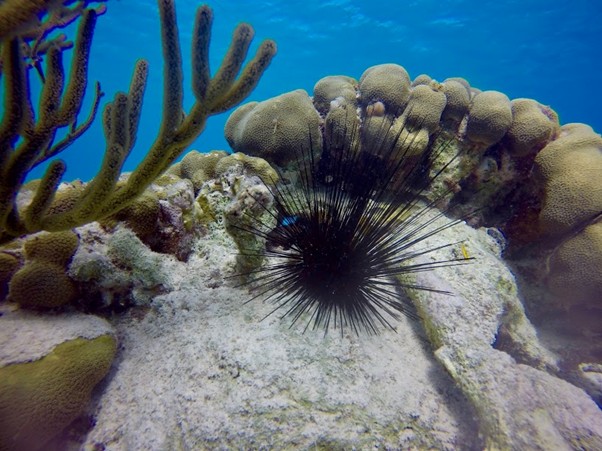
Photo by Kelly Perry – Long-Spined Sea Urchin
The method
I am not a qualified to talk about how to conduct a sea urchin count, so I have enlisted the help of Izzy, who has helped/ran the Sea Urchin Project with Opwall for 2 expeditions, to take me on an imaginary dive with herself and one of her research assistants (RAs).
So, we are on our dive boat, “The Tiburon”, we have done our pre-dive safety checks, run through the plan and the captain has given us all clear to get in.
We descend to where the reef is at a depth of 10m. Izzy takes the lead with a dive slate in hand. On the slate is a tally of fish species we are likely to sea during our dive. Izzy’s job is to recognise and record all the species she sees which requires a fair amount of homework before she even dips a fin into the sea. While undertaking this task she is also keeping one eye on her depth gauge as this survey needs to stay at a depth of 10m.
Following Izzy is one of our research assistants who is carefully laying down a 50m measuring tape following the route that Izzy takes. This is no easy feat as the tape measure needs to be kept taught by zig zagging its path through nooks and crannies created by the hard coral, while of course not damaging or disturbing the myriad of brightly coloured organisms which make up and inhabit the reef.
Following these two titans of coral reef conservation is me, with a GoPro camera in my hand, nervously waiting until I have enough space to conduct my component of the survey. I have been given the role of recording the benthos below the tape. Trying to keep the camera 30cm above the tape, to give a good view of the flora and fauna beneath, I set off at a steady pace. As I follow the meandering path of the tape, trying not to be distracted by a beautiful Cyphoma Gibbosum (a 1-inch sea snail with a pinkish shell with small orange dots). The extraordinary little creature feeds on soft coral and repurposes the polyps’ toxins to make itself unpalatable to predators. Midway through patting myself on the back for my find I remember I am conducting important research!
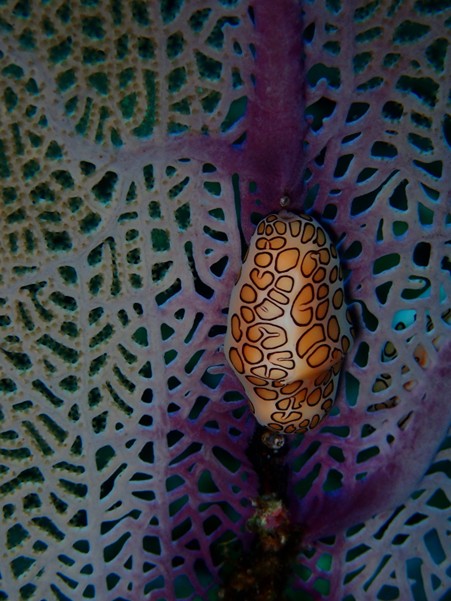
Unknown photographer – Cyphoma Gibbosum
Mind back on the transect I find the tape in front on me is not facing the correct way up to read the measurement on it. I remember one of Izzy’s pre-dive tips. If I run my hand beneath the tape, but far enough in front of me so that the camera doesn’t pick it up, it will ensure the tape measurements are facing up towards the camera as well as helping to guild me forward while swimming over the reef.
Following the survey tape takes around 8 minutes to complete. The tape is then tied off and we begin the second part of the survey. Izzy has already swum 10m back the way we came to begin to calculate a habitat assessment score (HAS). Without delving into this to much a HAS measures various factors like rugosity, variety of coral growth forms, and the percentage of live and dead coral cover, as well as other substrates like sand or rubble. If you want to read more about this here is a link to a 2005 paper by Gratwicke & Speight. Izzy conducts this at 10m intervals on alternative sides of the transect.
The RA and I then follow the transect tape back along the route either side of the tape. We are counting the number of Diadema antillarum we encounter within 1m of the tape on our side. This return journey requires a little less of my concentration and I manage to spot a variety of interesting reef creatures I missed on the original journey including a beautiful juvenile Microspathodon chrysurus, affectionately nicknamed the “disco ball fish” due to its jewel like spots all over its body.
When I do find an urchin, I am able to identify it due to its dark body and long spines, in this case black, but which can be a vary in colour. I record it and its morphology as well as if it is a juvenile. Juveniles would have black and white bands and even more disproportionately long spines to body size.

Phtographer unknown – juvenile sea urchin
When we all reach the end of the transect, we wind the tape back in and congratulate each other for a successful dive with a high five and return to the surface. Despite being a little more intense than one of my usual dives I feel a real sense of achievement and enjoyment from seeing the reef from a macro perspective.
I hope this gives you an insight into what it is like to conduct sea urchin counts on an expedition 😊


© 2026 Operation Wallacea Ltd. Website by Yello Media.
Social Media Links