
As an ornithologist in Romania for the 2026 season I was highly excited to see what the birds from the Tanava Mare region had to offer. The first day was tiring with an early flight out from the UK, I arrived in a storm wrapped Sighisoara. The Saxon town crammed with quaint streets and archetypal architecture of its German 12th century craftsmen. The streets paved with its cobbled stones made for a long walk to Hotel Transylvania, my rest stop for the night, but a traditional Romanian soup and dinner prepared me for the whirlwind adventure to come.
Day 1 started with a band of smiling faces at the entrance way, my staff peers for my three weeks with Opwall. The drive to Angofa along winding roads and dirt tracks quickly brought us from civilization out to the heart of the Carpathian Foothills.
The rolling valley cocooning the traditional hay meadows crammed with biodiversity capture a traditional way of life sadly slowly being lost from much of Romania. This is due to EU grants allowing big scale farmers to plough up the meadows in search of increased profits in more intensive corn crops. This is sadly destroying the health of the soil which would take at least 5-10 years to repair and even then may be nowhere near as biodiverse as previously.
The Angofa wildlife Centre which was to be our home was once the primary school to a community which slowly migrated to the outskirts of Sighisoara during the rule of Ceausescu, bricks and all. Apart from the old school and a farmhouse there is now no trace at all of the village which once stood around our base.
Credit: Ryan Ellul
The heat was stifling, having arrived in the midst of a Europe wide heatwave. With temperatures reaching into the mid 30s it was going to be a hard stint of fieldwork. A brief outing on our first day for staff orientation resulted in us nearly getting soaked in a thunderstorm which thankfully skirted along the valley side. We were all mesmerized by the landscape and the beauty of this historical region.
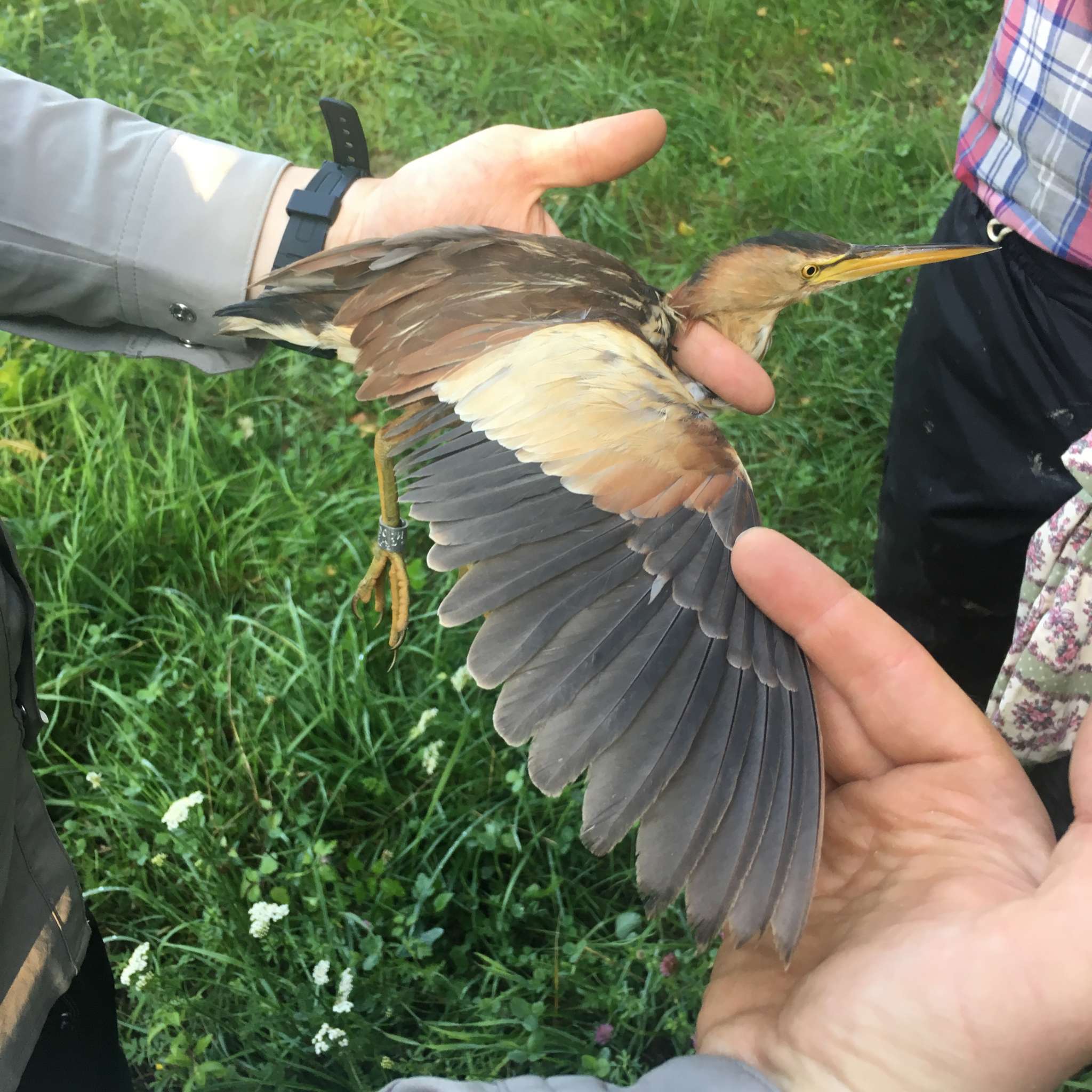
The first night the Research Assistants arrived we had a talk covering the likely birds to be seen in the area giving a chance to share and discuss knowledge before heading out into the field. We jumped straight into the week with a relaxed mist-netting session. Catching just a handful of birds including green woodpecker, jay and wryneck which gave the Research Assistants a chance to see a variety of species while also giving time to learn the basics of bird ringing from moult strategies to aging criteria.
Our following session was again relatively quiet but we did have the undoubted highlight of a lesser spotted woodpecker, a species so elusive in the UK it was almost hard to believe I had one in my hand!
As well as bird-ringing, we undertook point counts, walking the landscape and surveying the species noted at different points. These surveys turned up some great results such as bee eater, serin, lesser spotted eagle and black stork. The students loved seeing the birds close up in the hand and exploring the local farm and surrounding area in search of all things bird.

Credit: Eva Parks
A farm visit lead by Mada, one of the AEDPT staff – the organization owning and protecting the surrounding landscape – was fascinating, giving us a chance to understand the local techniques and struggles such as dealing with bears.
Week one was incredible and a lot of fun with much time spent outside surveys hiding in the shade on beanbags.
I cant wait to get stuck into another week at Angofa and one in Messendorf, a neighbouring village. Opwall really provides a fantastic opportunity to Research Assistants to learn about the techniques needed to be an ecologist , but also allow the staff to knowledge share, network and for all to enjoy a new environment in an incredible country.
Written by Alex Rosenfeld. Title Photo by Ben Porter


© 2026 Operation Wallacea Ltd. Website by Yello Media.
Social Media Links