We have a number of talks coming up about our expeditions, register for a talk by clicking here!

The Wallacea Trust Murray Grant

  •  

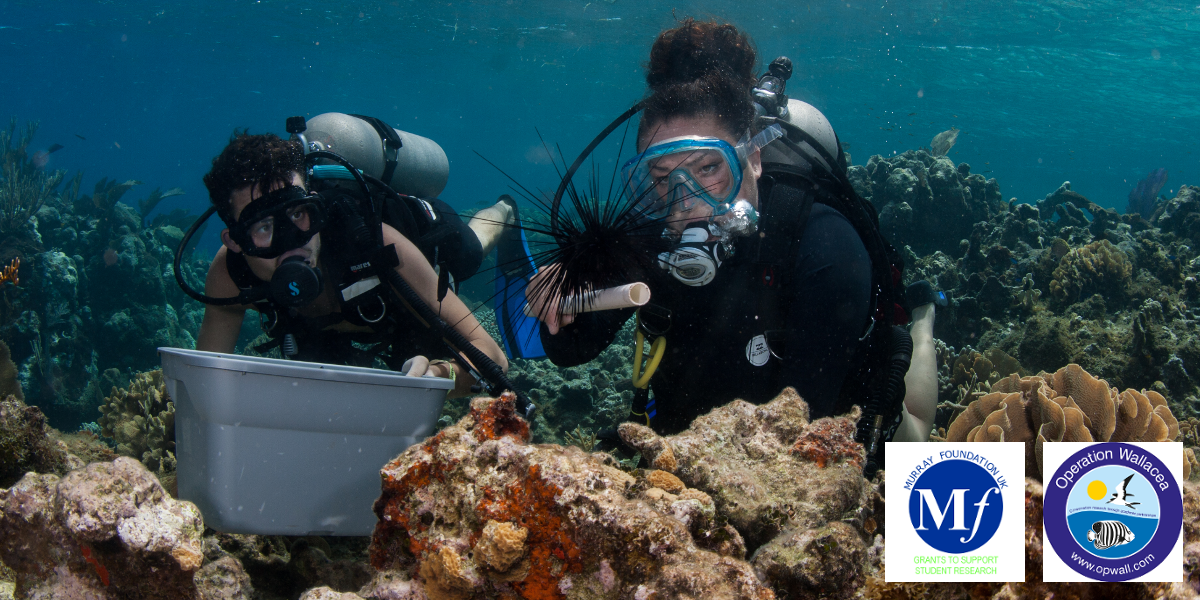
    The Murray Foundation was a charity established to support young people participating in projects which advance education and develop an understanding of environmental processes. The charity has now been absorbed into the Wallacea trust (Charity No: 1078362). The Wallacea Trust is a charity which Opwall works very closely with, to use the data we collect and develop them into long-term conservation management strategies. They also support organisations and individuals to achieve conservation goals.

    In line with their own goals and those of the Murray foundation, the Wallacea Trust are very generously providing £5000 of funding to support our school groups, research assistants and dissertation students this year! There is a maximum award of £1000 for individuals and small groups (up to 8) and a maximum of £2000 for larger school groups (above 8). The final award may vary and will depend on the number and quality of applications.

    The Application Process for Schools groups and Research Assistants/Dissertation students is slightly different so make sure you are reading the correct application information. There are also different deadlines so ensure you submit yours on time!

School Groups Application Process

  • DEADLINE EXTENDED – Tuesday the 15th of April 2025

    In order to apply, we want to hear about how your school group has been working together to fundraise for your expedition. You can submit this in any format you like, in the past people have used videos, slideshows, posters or poems. As long as it’s creative and captivating we’re not fussed. This can also be a great opportunity to get your students even more excited about the expedition.

    Applications must be submitted before midnight on Tuesday the 15th of April 2025.

    Please submit your final application by emailing the file (whatever format that may be) to murrayaward@opwall.com and remember to share some high quality images through https://wetransfer.com/ and list murrayaward@opwall.com as the recipient. Click the link below for more information on what to include in your application.

    Successful applicants will hear back by Tuesday the 22nd April 2025.

    *Please note that all submitted materials may be used to advise future volunteers in the form of case study documents, presentations and social media posts. In addition, all successful groups will be expected to provide a short report upon their return from expedition.

    Application Guidance

Research Assistants/Dissertation students Application Process

  • APPLICATIONS NOW CLOSED

    To be eligible for this award you must be a resident of any European country (including UK and Ireland), enrolled in any UK or European university and booked on to an Operation Wallacea field-based Expedition.

    Please email your completed application to murrayaward@opwall.com. The text of your email should include your name, contact information and the name of your university. Alongside this email, please include the following 3 attachments:


    • Full CV outlining academic achievements to date, employment history and future aspirations.
    • An academic reference, preferably from your university supervisor
    • A short paragraph outlining how this grant and the expedition as a whole will benefit your future career. Please include details of other work you are doing to gain experience in the field (max 600 words).


    Applications for the Wallacea Trust Murray Grant 2025 are now closed. Successful applicants will be informed by 18th April 2025.

    Candidates will be shortlisted based on their applications, and may be required to be available for interview.  On return from expedition you will required to provide a short report and photographs about your expedition to Operation Wallacea.

Murray Foundation 2019 School Recipients

  • 2019 was our third year working with the Murray Foundation and running this Award. It was hugely successful and enhanced the expedition experience of five of our wonderful UK school groups –  Alcester Grammar School, Callywith College, King Henry VIII High School, Kingsmead School and Stratford-upon-Avon School. Post-expedition, each group was asked to write a short report and share their experiences with us:

Alcester Grammar School - Fiji 2019

Our group came from Alcester Grammar School in the West Midlands. Our expedition group consisted of four year 12 students and 14 year 13 students and our supervisors were our teachers, Mr. Gill and Ms McLean. Everyone in our group who came onto the expedition were very eager about the study of ecology and biology as a whole and so we were all passionate about the trip and had an enjoyable time whilst out in Fiji.

Fundraising for the trip was done in many different ways. as a group we had no group fundraising pot but rather did so individually. Many people such as myself got jobs to help fundraise for the trip for example I (Harry Benton) got a job working at McDonalds to help fund the trip, taking me 6 months of working. Another of our group setup a quiz night and raffle helping them to raise somewhere in the region of a brilliant £800 for the trip.

Everyone on the group prepared separately, but we had a few meetings on the lead up to the trip to help us prepare, as well as some extra activities that were needed. We were given a list to help us pack what we would need, to ensure the expedition went smoothly and was enjoyable including medical supplies and rainforest friendly clothes. We were also informed on the importance of biodegradable wash products so we had to locate some for the trip, which was kindly donated by green people. This company was a good call, as their products were made from 100% biodegradable products which we would be able to safely use in the rainforest without damaging the delicate ecosystem that is found in the area. We also managed to get these products for free, in exchange for publicity for their products which allowed use to easily acquire biodegradable products whilst raising awareness for a brand. We were also taught the customs to use for when we stayed with the locals for 1 day and 2 nights so we could create a welcoming environment for the locals that were hosting us.  In preparation for the marine week on the Fiji expedition, we were recommended to acquire a PADI diving license which would allow us to start helping the onsite researchers a lot quicker as we were already qualified to dive. Most of the group went on to do this, with some deciding to learn at the site. Some of us had already earnt a diving license so we arranged a day after school, in which we met up at the local leisure centre to have a refresher on diving in a pool, in which we were shown hand signals and procedures for assembling and disassembling the gear. We also managed to get a sponsorship from the company Gul which allowed us to have wetsuits for the diving sections of the trip. Without these suits we would have been less prepared for the trip when we arrived, having to borrow the wetsuits that were already there.

The trip began at Alcester Grammar School on the 12th of July 2019. We had a brief meeting with the trip leader Mr. Gill before loading the minibus for Heathrow. From there we had a 13hour flight to Singapore where we spent an hour or so making our way to the connecting flight to Nadi, Fiji which was another 10 hours. After our arrival we had another small flight to Savusavu where we had a nice meal in the harbour before getting the bus to the homestay village of Vusaratu where we were greeted with a warm welcome and fed some traditional Fijian food before going to bed with our homestay families. The house was very nice and welcoming especially after having travelled such a long way to get there. Me and one other student were staying with one of the older residents of the village and was keen to take care of us and make us feel as if we were part of a family. We each had our own room that was fully prepared for

us with mosquito nets being hung over both our beds to protect us from the mosquitoes. In the mornings we were treated to many delicious foods for breakfast, the highlight being the scrambled eggs and bread that we were provided with which had a very unique taste compared to their counterparts in England. Our homestay was very curious about our lives and so we were happy to talk about our experiences in England and how we were enjoying Fiji. The first day in the village of Vusaratu we were given a village tour where the locals showed us their way of life and things that people would do on a normal day in the village such as mat-weaving and collecting certain plants for medicine or for earning money. Later that day the locals treated us to a lovo dinner on the beach before we went to bed ready for the big hike up the hills to the forest camp the following morning. The hike up to the forest camp was long, slow and difficult in the heat of the day however we did all eventually make it before lunch and our afternoon activities. We had planned to take a coach up to the start of the trail, but it never arrived so we had to start our walk from the village, letting us take in more of the surroundings than we would have.

The 1st week in the forest camp was worked on a rota of spiders, habitats, butterflies and birds. Every day each group did something different until they had completed all of the tasks. My personal favourite was the butterflies as we managed to catch a butterfly that has never been found in the Natewa peninsula before. Although the butterfly was not a new species it had never been recorded in this particular area, so it was a very exciting moment for our group. Once all was done we had to leave the beauty of the rainforest behind for the marine camp. The views there were breath taking over the bay which is the largest bay in the south pacific. during the second week we carried out underwater surveys or some people got their PADI certification or like me, went snorkelling. On the Wednesday morning I stepped outside the tent to see everyone on the beach looking out into the bay during what was meant to be breakfast. To everyone’s surprise, there was a whale out in the middle of the bay where everyone was staring in awe. The rest of the time in the water camp we played various card games when we were not out in the water. After an amazing time in rural Natewa bay we sadly headed to Nadi for 2 nights in Bamboo-backpackers where we went to the garden if the sleeping giant and the Sabeto hot springs. before embarking on the long journey home.

What did we gain and learn from taking part?  We gained knowledge on how the job of ecology works in a real life setting and the types of conditions people work in for the type of job they do. We also gained an appreciation for different cultures from the other side of the world and how different their way of life is to ours, whilst learning about their way of life and how it differs from ours in a more developed country and discovering their viewpoints. Every night once we reached the forest camp and then the marine camp, we were provided with a very engaging lecture on the ecology of the islands of Fiji, some examples of the types of lectures we were given were about the different types of coral and fish in Natewa bay and how to identify and categorize these. Another lecture we were given, that was in the forest camp, was about the different types of islands in Fiji and how the positioning of these islands affected the migration of different species, such as birds and of course humans. We also learnt of the endemic species that were only found on the island that we stayed on Vanua Levu and more specifically the Natewa peninsula, for example the Natewa silktail and Papilio natewa (a swallowtail butterfly). We left with an overall greater understanding of the subject of ecology and more so the ecology of Fiji which will be very useful for the future for all of us if we go into the field of Biology, and a perfect way to get into ecology as a fulltime job. Even for those that do not want to go into ecology, the experience is an invaluable source of information and experiences that will make all of our group stand out from the rest of the crowd, showing our high interest in amazing projects such as this one. It may in the future even lead to some of us being the pioneer of a new discovery in the field, thanks to this expedition.

Callywith College – Honduras 2019

On our first day in the Cloud Forest of the Cusuco National Park we hiked from the base camp up the mountain to a smaller and more remote satellite camp called Cantillos. Our time at Cantilllos was spent carrying out herpetofauna surveys where we learnt about how to capture, classify and safely handle snakes and how to collect and swab frogs. The surveying was necessary in order to determine whether the frogs had chytrid fungus, a pathogenic fungus which affects the keratinous tissues of amphibians and is feared may lead to the next global mass extinction. We learnt how to set up a light trap which enabled us to attract and capture a wide variety of moths and jewel scarab beetles which are endemic to the Cusuco National Park. We visited the Dwarf Forest where the high altitude causes the trees to be very short; the dwarf forest was full of delicate red flowers and we were also able to see views over the whole park from the top. We also spent time with the bird team: we captured two slate coloured solitaires and a hummingbird in our mist nets! After spending 3 nights in a hammock at the satellite camp we then hiked back down to the base camp.

We spent a further 4 nights at base camp and we participated in a lecture series which included lectures on chytrid fungus, the animals and insects of Cusuco, rainforest conservation and rainforest services. Also while at base camp we went on more herpetofauna surveys. It was interesting to be able see how the snakes and amphibians differed between the camps due to their different altitudes. Additionally we went out with the bat team where we learnt how to assemble a mist net to capture bats, and how to process and release bats. Furthermore, we spent time with the bird team again, this time we went on a point count and attempted to learn the bird calls. We found it difficult to remember and differentiate between the different bird calls but the point count was very enjoyable!

After spending a week in the rainforest, we travelled by 4×4 followed by an old American school bus, coach, ferry then another coach across Honduras to Roatan, the largest of Honduras’ Bay Islands. Over the week on Roatan we successfully completed our PADI open water dive qualification, with 5 confined water dives and 5 open water dives. We learnt specific skills such as how to empty a fully flooded mask, how to remove all your equipment underwater, how to share air with a buddy in an emergency, CESA (Controlled emergency swimming ascent), how to drop weights in an emergency, BCD oral inflation above and below the surface, five point descent, five point ascent, how to control buoyancy, how to safely enter the water with a backwards entry and how to plan a dive using dive tables. While on our dives we saw a wide variety of corals such as stag horn coral, yellow tube sponge, brain coral, giant barrel sponge, sea fans and lettuce coral. We also saw a wide variety of marine life including a green turtle, spotted eagle rays, green moray eel, midnight parrot fish, spotlight parrotfish, sea urchins, angelfish, damselfish, wrasse, snappers and sergeant major.


King Henry VIII High School - Dominica 2019

We are 16 students from King Henry VIII School in Abergavenny, South Wales. In the summer of 2019, we went to Dominica, the “nature island” of the Caribbean. Dominica is the most mountainous and biologically-diverse island in the Lesser Antilles, home to 9 dormant volcanoes and hundreds of different species of endemic flora and fauna. The expedition involved a week in the jungle followed by a week by the sea. We helped collect data for Operation Wallacea and the collaborative world-renowned scientists and university students. In 2017, Hurricane Maria hit Dominica, devastating the island. Consequently, the research we collected is some of the first evidence of the effects of the hurricane on the island. Our school group was comprised of 15-19 year olds, who saw this expedition as an once-in-a-lifetime opportunity.

As a group, we used several fundraising methods in order to raise money for this expedition. Firstly, we decided to write sponsorship letters to send to various companies. From these letters we were able to gain sponsorships from six companies, raising a total of £634.20.We decided to set up stalls at some events, including a school fete, in which we raised money from games such as throwing/kicking a ball through a hole and guessing the sweets in a jar. From these events we raised £149.16. The biggest fundraising event that we carried out was a quiz which we held at a local pub that kindly allowed us to use the pub for the evening. During this we hosted around eight rounds of questions with an interval in-between. We raised money from tickets that we sold to people who wanted to attend the quiz, from food that was made by the owners of the pub and sold during the interval, and from raffle tickets that we also sold during the interval – the prizes from which were announced at the end. The total amount of money we raised from this event was £400.66.

Another fundraising method that we used was taking sponsorship forms around and asking for small donations from people. One time we used these sponsorship forms was at a rugby presentation day, where we took a form to people who had attended the presentation and generally gained donations of 50p to a £1 from everyone there. We also set up Easy Fundraising and Just Giving accounts, using the Easy Fundraising account to raise smaller amounts of money throughout the year, raising over £200, and the Just Giving account to gain donations for our sponsored event, whereby a group of us counted our steps every day (via our phones) and aimed to walk the distance from Abergavenny to Dominica in steps, updating the amount of steps we had done every week or fortnight on a website we had set up. We raised over £150 from this. The website we set up was not only created to show a record of our steps, but also to show information regarding the fundraising activities we had done and were going to be doing, information about why we were fundraising and what the expedition was about, and a sponsorship page to show the companies that had sponsored us. The total amount that we raised as a group, not including any individual fundraising via part-time jobs and other activities, was £1716.72. Also, as a school, we raised money in order to reduce transport costs through buying and selling Krispy Kreme donuts during break times or lunch times in our school. Most of the individuals in our group also raised a lot of money through their own part-time jobs.

When applying for the Murray Foundation Award, we compiled information from the various fundraising activities we had done into a power point. Similar to the paragraph above, this power point showed the process we went through in our fundraising efforts and the amounts of money we raised from each activity. The power point also provided images from some of the fundraising activities, highlighting what we did in our fundraising efforts.

There were several aspects that we had to consider when preparing for the expedition. Firstly, we had to have a basic understanding of the types of wildlife we were likely to encounter when completing the various surveys on the expedition. To do this we used materials provided by OpWall and our school regarding the different types of wildlife. Secondly, we had to ensure that we were fully prepared in terms of the kit we needed to take, and to do this we used kit lists provided by OpWall an our school. We had to buy certain items that were needed for the expedition, some of which were more expensive due to being environmentally friendly and biodegradable, which therefore added to the overall cost, and so we needed to carry out further fundraising in an attempt to cover some of these costs. We also needed to have necessary vaccinations to prevent from certain diseases that could have been caught in Dominica, which meant making doctor’s appointments before the expedition. Furthermore, we had to ensure that our travel documents were in date to allow us to travel to Dominica, meaning that some of us had to update our passports, and this had to be done at least six months before we left. Our PADI documents needed to be completed in order to allow us to snorkel or dive when in Dominica, particularly for people with asthma who wanted to dive as this needed to be checked by doctors or specialists first. Additionally, we needed to attend several school meetings over the course of two years in order to keep up to date with all the necessary information for the expedition. We also needed to take certain amounts of US dollars and Eastern Caribbean dollars, therefore meaning that we needed to exchange some money at a travel agency or post office. Finally, we had to ensure that everything we needed to take to Dominica fitted in our bags, and was organised in a way that would be simple to unpack when we were in Dominica in order to find necessary items for each day.

On the 6th of July, we woke up at 01:00 in the morning to take minibuses to Gatwick airport. Armed with at least 2 rucksacks each, we boarded a plane to Antigua, the flight taking more than 8 hours. Our last two days of luxury before we arrived at camp consisted of experiencing exciting Caribbean cuisine, swimming in bath-temperature seas and staying in a hotel. By the 8th, we were sleeping in tents in the middle of the Dominican jungle.

In the first week, we stayed in an eco-lodge which is designed for tourists but is taken over by Operation Wallacea for 2 months of the year.  We bathed in a pool formed by a nearby river and were fed by local cooks. We had to cross 3 rivers to reach our camp, with one coming up to our waists. We took an active part in many different research projects including:

  • Mist netting – We woke up at 05:00 to catch birds and stayed out till midnight catching bats. However, Hurricane Maria has meant that the majority of the canopy has been destroyed, therefore increasing the amount of light reaching the forest floor. Subsequently, shrubbery has dramatically increased, including the invasive razor grass. This has meant space for birds towards the forest floor has decreased. Consequently. We caught a limited amount of birds and bats. Despite this, feeling a bats fur and identifying different species was an amazing experience and many of us were astounded by the size and speed of the Dominican bats. One group saw a pair of imperial parrots, which was extraordinary considering that it is believed that there are only about 20 of these birds left on the island.
  • Insect surveys – Led by Dr Erica McAlister, a world-renowned scientist from the London Natural History Museum, we caught flies and other flying insects with sweep nets and pooters, which involved us sticking our faces in nets and sucking up flies through a tube! Apparently some of the species we caught are now being displayed in the Natural History Museum!
  • Volcanology Day – Robert Watts, a volcanologist monitoring Dominica’s 9 dormant volcanoes took us on a tour around the island, explaining the structure and formation of the island due to historical volcanic eruptions and also the potential dangers posed to the current Dominican population. He then took us to Trafalgar Falls, an amazing 100m waterfall and plunge pool where we could swim. To reach the pool, we had to walk up 200-300m of boulders and were therefore led by a local guide.
  • Snorkelling- We travelled to Champagne Reef, which was on the Western side of the island. It is called this due to the Carbon Dioxide vents in the coral reef. There are only five countries in the world that have these vents, caused by volcanic activity below the sea bed. pH levels at the reef are around 7, contrasting with the usual ocean pH  level of 8.1. This is extremely useful, because ocean pH levels are predicted to reach 7.7 in the next 100 years due to climate change. Therefore Champagne Reef can be used as a sort of trial to see how ocean acidification will affect marine life and biodiversity.
  • Catching anoles- We caught anoles with a noose on the end of a stick. There are two types of anole (lizard) on Dominica, the native anole and the invasive anole. It is feared that the invasive anole is slowly pushing the native anole to higher altitudes, with potentially the prospect of extinction for the native anole. However, as we went up to Freshwater Lake to catch anoles, located at around 650m above sea level, we only caught the native species of anole.

On the 13th, Dominica was hit by a storm, which had previously been classed as a hurricane. Sudden downpours of rain covered the island all night and into the morning, meaning we were unable to leave the camp as the rivers blocking the entrance had risen by a metre in the matter of hours! Luckily enough the rivers had returned to their usual levels by the next day, so we were able to leave the camp to travel to Fort Shirley, the old French and British fort situated in the North of Dominica, where we stayed during the second week of our expedition. We travelled to the fort via boat, hoping to see some whales, however we only saw flying fish (which were still pretty spectacular!).

During the second week, students had a choice; we could either complete our PADI Diving Course or we could snorkel, collecting data and attempting to spot different marine life. Two students completed their PADI Diving Course whilst the other fourteen took part in the coral and fish surveys for Operation Wallacea. As part of these surveys, we learnt how to identify different species of fish (e.g. clown fish, scorpion fish, lizard fish, angel fish and damsel fish), sponge, corals and invertebrates. We also calculated the percentage composition of the coral reef on a 50m transect by identifying what was under the tape measure every 25cm (coral, invertebrate, rock , sand, algae). Given most of us had never dived or snorkelled before, it was a pretty surreal experience doing it for the first time in the Caribbean Sea!

By taking part, we all gained a significant experience of what travelling could be like if we chose to take a gap year or wanted to see the world. We saw first-hand the magnificent lives of scientists, and therefore realized how the work we study in school links to that. We learnt that living in a different country (even in a tent) is well worth it, even if some people find it challenging at first. This experience has inspired many of us to focus on pursuing biology or geography-related occupations and has made us realise that the variety of jobs available to us is wider than you can imagine. Furthermore, we were able to explore new cultures in the Caribbean, and met new people from Canada, U.S.A and scientists from around the world.

We spent the £1000 award by putting it towards the travel to Gatwick airport for all the students. This meant the cost of the trip dropped for each student, meaning we had a little more money to spend on buying equipment to prepare us for our expedition. We also bought matching turquoise hoodies so we were easy to spot! This meant the teachers were less stressed and more confident when we were travelling.

To conclude, we would like to say an enormous thank you to the Murray Foundation. You had a massive contribution in sending us on the most amazing experience of our lives!

Kingsmead School - Borneo 2019

It’s impossible to figure out where to start with this, we had the best two weeks of our lives so far, learnt more than we thought was possible (and we’d just sat through GCSEs and A Levels) and met some wonderful people as well.

This is us.

15 students from Kingsmead School in Hednesford. Jacob, Sam H, Sam C, Alex, Lily, and Oli had just sat their GCSEs, Charlie was heading into her final year at Kingsmead and Bryon, Kyle, Quin, Rianne, Jasmine, Meg, Jay and Kieran had just finished their A Levels and were hoping to be setting off to University a few weeks after we got back home. For every single one of us it was the trip of a life time, it turns out for Rianne and Oli if was even more life changing. As soon as we got back she changed her University course from Psychology to Biology and Oli signed up to take A Level Biology.

Fundraising 

We had to fundraise pretty much all of the money for our trip. Some of us had jobs, and our parents helped where they could but the two years leading up to the trip were full of fundraising antics. Car washes, bake sales (every Friday), bag packs, school concerts, shows, and our biggest money maker and own invention (probably) – The Zombie Run. When we entered the competition for the Murray Award we sent in a video showing exactly what we meant but let us jog your memories. Over 30 members of the sixth form dressed up like Zombies – their makeup professionally done by the drama department. Students from 11 to 17 had to run around the school grounds, collecting clues about who started the zombie apocalypse and ultimately finding a cure, the whole time avoiding the zombies that were waiting around every corner. The level of fundraising we had to do was hard, but we got to know each other really well and it made the whole thing so much more important for us.

Preparing for the Expedition  

Some of us (Rianne and Jasmine) are super organised. They had walking boots the second they found out about the trip and were shopping for environmentally friendly sunscreen before the first meeting. Some of us…we won’t name names, needed a group shopping trip 8 weeks before we set off. There was a lot of walking involved for all of us, worn in walking boots make feet happy – and the extra exercise helped us all get in shape, we can’t all be competitive swimmers like Meg!

Our Expedition

We set off from school at 2am to make it to London Heathrow on time, 4 flights later we arrived in Borneo and were met at the airport by Bryony and a few other members of the team. In an effort to stay awake for as long as possible we headed out into the town for waffles after our dinner.

The expedition really started the next day when we visited the COP centre and learnt a little bit more about why we were going to the rainforest. The staff there taught us about palm oil plantations and what they meant for the biodiversity of the rainforest, but more specifically what happened to the orang-utans that used to populate the forest that had been replaced. We were all prepared to hear about the burning of the forest, about how orang-utans are harmed if they venture on to the plantations, but none of us really understood how serious it was when the baby orang-utans are orphaned. We hadn’t even considered the impact it would have on their mental health, and the people at COP really showed us exactly how much work goes into rehabilitating the younger orang-utans before they can be released. As soon as we got back to school we started thinking about how we could fundraise for this charity because it became clear that it’s a very important cause that isn’t getting the attention that it needs. While we were at the COP centre we also met the students from the British School in Tokyo – our camp mates for the next two weeks.

Lesan Dyak was the next stop on the way to the rainforest. We met the villagers, learnt about how their village had been moved (again this was linked to the palm oil plantations). Everybody’s homestays were welcoming and we learnt a lot from the people that we met, including the music that they like and what their children were studying. After dinner we also got to take part in some local dances and learnt even more about the local culture.

Early the next morning we set off on boat down the river and got our first real glimpses of what it meant to be camping in the rainforest. Macaques were taking leisurely strolls along the edge of the water, gibbons could be heard howling and colourful birds took flight from trees when the boats got close enough. Upon arriving at the forest site we got a tour from Bryony, assigned tents, and then immediately got thrown into some practice. The year 11s and Charlie got to go on a butterfly walk with Roy, whilst the year 13s got to trek along the highway on a mission to spot mammals. That first day the highway seemed like the steepest hill, but after the first couple of days of jungle skills (what can we eat? How can we carry an injured person? What is Rattan and why shouldn’t you pull it straight out of your skin?), bat surveys, and habitats (our favourite activity) the highway seemed like nothing, and we were all a comfortable ‘jungle dry’ at all times. The Red Langurs causally hanging out by the river were our first ‘best sighting’ but nothing compared to being the first group to spot an orang-utan. The sight of all 15 of us (and Miss Reid) sprinting up the highway and towards transect A to see the baby orang-utan that had been spotted must have been hilarious to all of the local guides (although they were right there with us). The Herp night time walk was another highlight of our trip, trekking through a river in the middle of the jungle at night with nothing but our head torches and Scott’s ability to spot frogs and snakes, and not forgetting the occasional set of eyes floating at you down the river only to find out that they are water spiders. By the end of the first week none of us wanted to leave the jungle, we were all completely at home, we’d had some great sightings, set up camera traps, trekked through jungle storms, worked on mist nets, transects and learnt a lot about conservation in the rainforest. Needless to say leaving the jungle was a bitter sweet morning, on the one hand we had to say good bye to the jungle staff, on the other hand we were on our way to our new adventure on Derawan Island.

From the second we saw the jetty at Derawan we knew we were in for an excellent second week. Alan and Alfie were waiting to meet us on the jetty and after we were assigned to our rooms we had our welcome talk and our first PADI lecture. From this point we were split from our teachers completely, they’d already got their PADI open water and were working on projects and a lecture series with some of the students from the Tokyo school. At this point we’d like to mention how proud we are of Kyle, who didn’t think he’d be able to swim well enough to get in the sea let alone dive, and actually turned out to be one of the best divers in the group (next to Meg the Mermaid.) At first we didn’t believe Miss Reid and Mr Higho, we couldn’t understand why they were coming back from dives with goofy smiles on their faces making random fish signals at each other, but as soon as we had our first open water dive we got it. Drifting along in the current, spotting sea turtles, an octopus, angelfish, clownfish, and one tiny shark, the sheer biodiversity of the dives was amazing. We also got to see sites of blast fishing and Emily explained to us why it’s important not to judge the local people for relying on this method of fishing for so long in the past. At the end of the day, they didn’t understand the damage it was causing, had very few other sources of food and income. In the middle of the week Barbara arrived (the name we gave a sea turtle which would make up most of night time entertainment.) Two nights she made her way all the way up from the sea and spent hours digging a nest trying to lay her eggs. The first night the nesting didn’t go to plan and she made her way back down to the ocean while we were eating our noodles. The second night was a success! This has to be one of the top moments of the entire trip, seeing a sea turtle build a nest and lay eggs. We also got to go into the local village and visit the turtle hatchery, and it really made us realise that even the smallest group of people, in the most low tech situations can make a difference to conservation. One of the hardest things about watching Barbara lay her eggs was the fact that as soon as she started back towards the sea it became obvious that she was moving towards the electric lights attached the nearby hotels. The staff from the turtle hatchery were there to help her, and it gave us a real insight into how important the work they do is. Towards the end of the week we worked in small groups to research and create a presentation about an aspect of marine ecology, an we’ll be honest Charlie, Oli and Lily were the best with their shark impersonations and in depth knowledge of shark behaviour. None of us wanted to leave Borneo, we’ve only been back at school a few weeks and we’re already missing it as a collective. It really was a life changing experience.

What did we gain?

Most importantly we got to work with local people and scientists on real projects to make a difference in way that we just couldn’t have managed on our own. We also learnt some valuable scientific techniques – like working out the carbon storage in a tree, which we’re going to apply to looking at our own school site and then try to make it more eco-friendly, again using knowledge that we’ve gathered on the trip. We’re also looking forward to working with Emily again and setting up some conservation trips in the UK, maybe on the nearby Cannock Chase, maybe slightly further afield. Rianne and Oli learnt what they really wanted to do in the future and the rest of us fell even more in love with Biology and the paths that we’ve already chosen to take. We’ve made friends that we’ll never forget, from different countries and different schools.

How did we spend the £1000 award?

The money went straight into the pot with the rest of our fundraising money and helped us to pay for the trip and it was a complete life saver with exams edging closer and closer.

We’d like to finish by thanking you for your help, the extra £1000 towards our trip really helped us. Without the help of people like the Murray Foundation we would never have been able to go on this trip. Visiting Borneo isn’t the kind of opportunity that comes around very often in Hednesford, and it’s changed all of our lives completely, it’s something that we’ll never forget and it’s given us a huge amount of determination to help charities like COP and look closer to home to find ways that we can help maintain biodiversity.

Thank you so much!

Wallacea Trust Murray Grant 2025 Recipients

  • 2024 was the first year of the Wallacea Trust Murray Grant after the Murray Foundation was absorbed into the trust. It was hugely successful and enhanced the expedition experience for 2 of our wonderful volunteers. Post-expedition, each volunteer was asked to write a short report and share their experiences with us

Syvlie Williams: University of Edinburgh

I left the UK in June 2025 unable to scuba dive and with little knowledge of marine eco-systems. During four profound weeks as a research assistant with Operation Wallacea, I helped conduct benthic and fish surveys & assisted in the capture and dissection of over 50 invasive lionfish. I also gained a deep appreciation for the complexity and fragility of coral reef ecosystems & a passion for this area of study and research.
In Honduras, the marine site is in the Bay of Tela – home to a uniquely resilient coral reef that, despite heavy freshwater runoff and pollution, remained one of the healthiest in the Caribbean until the bleaching event of 2023. Opwall has monitored this reef since 2014, collecting benthic and fish survey data at multiple sites annually, along with lionfish samples to better understand their impact. Lionfish, an invasive species with no natural predators in the region, pose a significant threat to reef biodiversity. This season’s project focused on how their diet may have shifted following the 2023 bleaching event.
During my first two weeks, I completed both my PADI Open Water diving certification and a Caribbean reef ecology qualification. This involved daily lectures on coral ID, reef threats, and conservation practices, paired with hands-on training in key research techniques – from laying transects and quadrats to using underwater video rigs for benthic and fish surveys.
In the final two weeks, I applied these skills across two research teams. With the reef surveillance team, I helped to lay 50m transects and filmed benthic surveys using GoPros along these transects. I also assisted with fish surveys using stereo video surveillance (SVS) and assisted in daily data analysis. Benthic data involved coral, algae, and invertebrate ID, while fish survey footage was used to calculate biomass of identified fish, offering a more accurate ecological picture than traditional ID methods. SVS techniques for fish surveying are being pioneered by Opwall in their Honduran sites (Tela and Utila). With the lionfish team, I took part in daily dives to locate and capture lionfish. Post-dive, we recorded measurements, dissected the fish for sex and maturity, and analysed stomach contents – typically filled with small fish and crustaceans.
Throughout the month, I gained not only technical skills in scientific diving and data collection, but also a deeper understanding of how conservation science must integrate both ecological knowledge and local context. Tela’s reef is considered an ecological anomaly – it thrives despite conditions that should prevent healthy coral growth. Until the 2023 bleaching event, it was one of the healthiest reefs in the Caribbean, with high coral cover and low levels of algae. Scientists still don’t fully understand why it was able to flourish, which makes ongoing monitoring crucial. At the same time, local interest in marine life is limited, largely due to a lack of education and economic reliance on industries like fishing. This makes the work of Opwall and Tela Marine (Opwall’s local contact) especially important – not just for research, but for engaging local communities
through outreach, education, and ecotourism. Sustainable conservation here depends on both scientific data and community involvement.
Now continuing my studies at the University of Edinburgh, I’m excited to carry this experience into my academic work – particularly in sustainability and environmental chemistry. This placement confirmed my passion for marine science and I’m incredibly grateful the Murray award for making this opportunity possible. I grew so much – as a researcher and as a person – and I would love to return to similar work in the future.

Jacob Bugg: University of Bristol

Spending two weeks camping in the jungle was so much fun. Having no access to the outside world was so refreshing, it felt good be completely present surrounded by loads of insects, birds and the many spiders that ended up inside the tents. Some of my favourite moments were waking up before sunrise, having lots of mangoes for breakfast, and setting up the mist nets. Learning how to sample, handle and process load’s of incredible birds. Herp surveys were another highlight, getting to find loads of frogs, snakes were amazing, as well as the insect, getting to see all the endemic species.

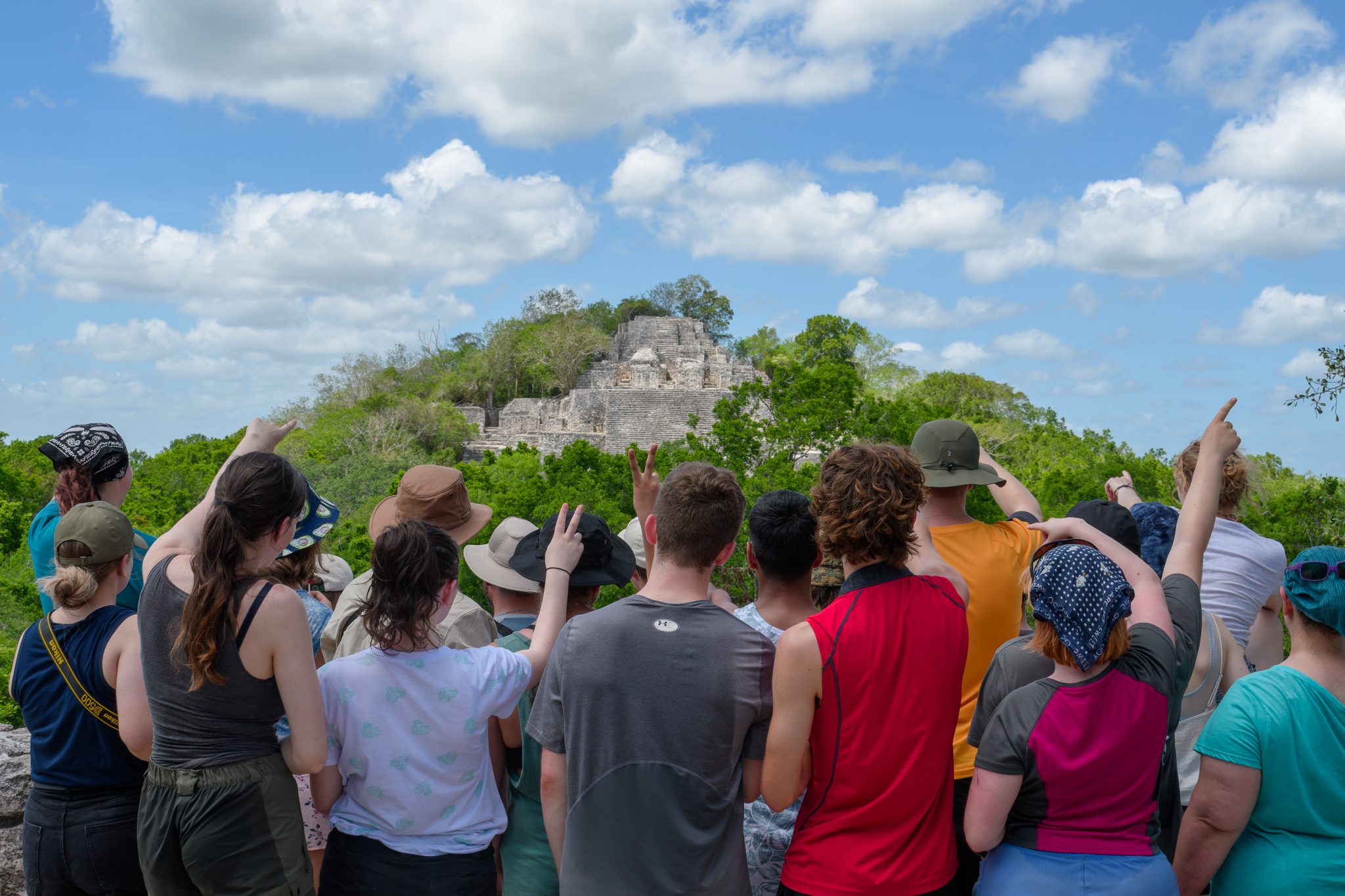
One of my favourite memories was when it started raining hard and everything was flooding, getting to dig trenches around the tents was super fun. Exploring the Mayan ruins was another highlight. Seeing huge groups of spider monkeys swinging over camp was incredible. The staff and local guides were brilliant, so knowledgeable and enthusiastic and I learned a massive amount.

The next two weeks were spent in the marine site. Learning to dive was incredible, the instructors were so much fun, and I’ll never forget turning around on my last training dive and seeing a nurse shark coming to check us out. Doing underwater quadrats was a completely new challenge, but such a fun skill to pick up in a totally new environment. One of my favourite tasks was cleaning coral in the nursery with a toothbrush, putting our buoyancy skills to the test. On our final day we got to swim through the swim-throughs built up by corral, which felt like cave diving and was so much fun.

Throughout the whole experience I made so many lifelong friends, nothing bonds people quilt like waking up to an ant colony trying to move into your tent. The staff and guides were so kind and knowledgeable, and it was super fun to work and learn from them on and about their conservation projects.

Martin Suthers’ Grant

  • 2025 Applications are open!

    Martin Suthers was a good friend to Operation Wallacea, and acted as Trustee and then Chairman for the Opwall Trust for 16 years. When Martin sadly passed away in 2016, he left a legacy to help students get out in to the real world and gain the hands-on field experience required for a career in conservation.

    The Martin Suthers’ grant is available to those who are embarking on any expedition as a research assistant in the summer. There are two grants of £250 available each year and, as with most grants, there are specific criteria that volunteers must meet to be eligible to apply; you must demonstrate that you have made the effort to fundraise a significant proportion of your expedition costs already.

    After raising a minimum of £500, you can apply for this grant by telling us exactly how you did it. To support your application you must also be able to supply at least three photos of fundraising activities, and/or any promotional materials you used (posters, leaflets, tickets etc). Successful candidates will be chosen based on the commitment and creativeness of their fundraising.

    To apply, please complete our online application form. via the link below, and send your supporting documents to fundraising@opwall.com via the file sharing website wetransfer.com. The deadline is midnight on Monday 14th April 2025.

    Please note that the information you provide us with may be used to advise future volunteers on their fundraising. This could be in the form of case study documents, presentations, and social media posts. In addition, successful applicants will be expected to provide a short blog outlining their expedition experience on return to the UK or Ireland.

Guy Poland Grant

  •  

    In 2014 Guy Poland joined an expedition to Mexico with Clifton College, seeing the impact of this expedition on teachers and students left a big impression on Guy. He was a talented and enthusiastic scientist who died in 2021 aged only 39.

    At Operation Wallacea we have been fortunate to work with Guy’s father, Dr Roger Poland for many years and he has not only led expeditions with his previous school he has worked at many of our research locations. He has also spent the last two decades assisting teachers and students with using Operation Wallacea data for classroom teaching and students own extended projects.

    Rather than receive a wage for his time and efforts Roger has asked that money be paid into a legacy fund to mark his son, Guy’s life. This means students who were unable to consider joining Operation Wallacea due to costs will be able to apply for this fund.

    The funds are available to cover the expedition fee and some additional costs associated with joining an expedition.

    To be eligible for this award you must be a resident of any European country (including UK and Ireland), and meet at least one of the eligibility criteria below:

    • Have an annual household income of under £40,000
    • Care leaver/ Care Experienced
    • Carer/ Caring Responsibilities
    • Estranged Student

    There is one award available so please ensure you apply before the deadline.

    Please read the eligibility criteria carefully before making an application, as you will be required to provide evidence of eligibility as part of the application process.

    Please email your completed application to fundraising@opwall.com. The subject line should be your name, followed by “Application for the Guy Poland Grant”. The text of your email should include your contact information and the name of your university/school/employer. Alongside this email, please include the following 3 attachments:


    • Full CV outlining academic achievements to date, employment history and future aspirations.
    • An academic reference, preferably from your university supervisor or teacher.
    • A short paragraph outlining how this grant and the expedition as a whole will benefit your future career. Please include details of other work you are doing to gain experience in the field (max 600 words).


    If your application is selected to move to the next stage of the process then you will be expected to be available for interview. You will also need to provide evidence that you fit the eligibility criteria. All aspects of your financial and personal circumstances will be treated in complete confidence, and you may withdraw your application at any time. View our privacy policy here.

    The Application deadline is the 20th April 2025. Applicants will be informed by the 25th April if they are moving forward. On return from expedition you will required to provide a short report and photographs about your expedition to Operation Wallacea.

Guy Poland Grant 2025 Awardees

Lauren Brown

I am a third-year BSc geography student at Royal Holloway university of London. Over the past year, my academic studies have deepened my interest in fieldwork and conservation. This inspired me to take part in a research expedition with Operation Wallacea, where I had the opportunity to apply my knowledge in a meaningful environment. During the summer, I spent 4 weeks in Croatia, Krka National Park as a research assistant. This was my first-time conducting fieldwork abroad which was both challenging and extremely rewarding. The site was incredible, full of rich biodiversity and amazing views which surpassed my expectations.

I thoroughly enjoyed participating in every survey, but I was particular fascinated by bird mist netting, bat harp trapping, mammal and habitat surveys. During my final two weeks, I chose to specialise in habitat surveys, although having enjoyed data collection with other taxon teams, I continued to join a few other surveys to broaden my understanding on the site’s biodiversity. A highlight of my experience was leading a habitat survey to a group of school students, which allowed me to share what I had learnt in the field and develop my confidence in communicating scientific information. I was also keen to assist with data entry, so in my final two weeks I worked on data entry across multiple research teams including watching camera trap footage with the mammal team.

The month I spent in Croatia provided me with an invaluable set of both practical and personal skills. Through fieldwork surveys, I strengthened my abilities in ecological data collection and monitoring, species identification and working efficiently in different settings. Collaborating with research assistants and staff enhanced my teamwork, communication and problem-solving skills as we often had to adapt to field conditions. Working in this collaborative environment enabled me to grow in confidence, particularly when contributing ideas within a group. This experience has deepened my enthusiasm for conservation research and has equipped me with a strong foundation for a future in this field of work.

I made countless amazing memories during my time in Croatia. A highlight from a bird mist netting survey was when it started raining on our way back, we had been longing for some rain,. Habitat surveys were always great fun, bush whacking, crawling and climbing over plants and trees. Beyond the surveys, socialising with research assistants and staff during mealtimes and throughout the day was memorable, playing card games and chatting, it created a strong sense of community. Days away from surveys were also very enjoyable, I got to explore areas of Croatia outside of Krka Park, including several waterfalls and Sibenik town. Croatia was an unforgettable experience, and I am incredibly grateful to have been awarded the Guy Poland Grant, which made this opportunity possible.

Jerret Raffety

Greetings. I’d like to introduce myself – I’m Jerret Raffety. I was a participant in Operation Wallacea’s Field Skills for Wildlife Management Careers course at the Knepp Estate in West Sussex in July – with the assistance of the Guy Poland Grant. To better communicate why I chose this course, I’d like to explain my background. I’ve spent six years working in journalism and another eight as a teacher and – during this time – I gravitated towards stories and lessons about environmental topics in the hopes of making the case to my audience that these matters are of paramount importance to our future. However, whether it was photographing the Adobe Town Canyon in the U.S. state of Wyoming in order help the public understand what could be lost if oil development in that region wasn’t kept at bay or attempting to make the case to my students that their lifestyle choices can have an impact on climate change, I had begun to feel that addressing these topics indirectly was lacking in observable results. After becoming a father, I decided that acting indirectly to improve the natural environment for the next generation was not enough and I needed to be involved directly in this effort. Soon, I completed an MSc in Conservation Ecology. Through it – I’ve come to understand how environmental problems are researched and addressed while also deciding my career ambition: a role as an ecologist or biodiversity officer in a civil service capacity.

My university studies also introduced me to the Chartered Institute of Ecology and Environmental Management (CIEEM) and I have since joined as a qualifying member. Doing so has introduced me to CIEEM’s Competency Framework: a series of skills required to perform professional roles in the environmental sector – organised into a table to explain what skills are required or desirable for each role. The framework provides benchmarks to define levels of competency in these skills ranging from ‘foundation’ to ‘authoritative’. While applying for membership, I selected skills I wish to reach higher competency with so as to upgrade from a ‘qualifying’ to an ‘associate’ membership. It was fortuitous that I was applying to CIEEM and Operation Wallacea at the same time because I was able to see which skills were necessary to attain the job I want through this framework and I could then evaluate which of Operation Wallacea’s courses offered relevant instruction and experience towards these skills.

It was the field skills course at the Knepp Estate that addressed specific competencies I require to progress in my CIEEM membership and, thus, my overall employability. These included: habitat/species survey design, planning and fieldwork; species identification, handling and population size as well as habitat identification, classification and assessment. These competencies – as well as the offerings of the field skills course at the Knepp Estate – coincided with legislation enacted in the U.K. in 2024 directing that ecological assessment on behalf of developers in the U.K. be carried out with U.K. Habitat Classification (UKHAB) surveys so as to calculate a site’s biodiversity value using the Department for Environment, Food and Rural Affair’s biodiversity metric. This process provides data to follow this legislation’s mandate that development projects increase biodiversity by 10% through onsite or offsite means – otherwise known as Biodiversity Net Gain. Modules on these methodologies featured prominently in the field studies course at the Knepp Estate and were my favourites for both their relevance to my career ambitions and my passion for having knowledge of varied habitat types and the value of each for the U.K.’s recovery from nature depletion. This passion comes from my belief that our greatest hope for nature recovery is to turn development into a vehicle for increasing biodiversity.

However, the course modules that I favoured most were only part of the story. The field skills course at the Knepp Estate involved courses that are not only relevant to an aspiring ecologist, but anyone interested in understanding how the health of British ecosystems are measured. These included bird surveying methods like point counts and mist netting; large mammal surveys via camera trapping and transect-based patch occupancy; bat surveys via acoustical recording techniques; herpetofauna surveys such as transect and refugia surveys; carbon stock estimation using the Woodland Carbon Code; and invertebrate surveys carried out through sweep netting, malaise traps and light traps as well as specimen sorting thereafter – amongst others.

The Knepp Estate was an excellent site for carrying out these methodologies due to its biodiversity. The Knepp Estate is a fulfilment of my own hopes for the of future of conservation due to its process of ‘rewilding’. This site was once a family farm that had become unprofitable. The owners – Charlie Burrell and Isabella Tree – opted to return the land to nature by allowing natural processes to take over, which they aided by introducing free-roaming grazing animals such as English longhorn cattle, Exmoor ponies, Tamworth pigs as well as roe, red and fallow deer to act proxies for ancient herbivores who once roamed the area. Further reintroductions as well as nature’s return meant that the estate also became host to beavers, white storks and the famed purple emperor butterfly – which leads me to my favourite moment of the course. I was walking back from surveying with my fellow students. We were lamenting that we’d likely missed the season for sighting purple emperor butterflies – with our studies being in the third week of July. We stopped at a tree known for sightings of these beautiful invertebrates and, as soon as we’d given up, a slightly ragged but still lively purple emperor landed on the shirt of my fellow student. It stayed there and allowed for photographs and even discussion of its features – a special sighting for a Lepidoptera enthusiast like myself.

I want to express my sincerest thanks to the Poland family for making this moment possible – as well as the highly targeted learning described above. It cannot be overstated how much both are of the highest personal and professional value to me.

Wallace House, Old Bolingbroke, Spilsby, Lincolnshire PE23 4EX, UK
| +44 (0) 1790 763194 | info@opwall.com